Recreating the ZX Spectrum
“Why are old people on YouTube? Horror show of tech freaks!”
That’s probably the only negative comment I’ve received on YouTube about this project — recreating a 48k ZX Spectrum from all new components. I’m not entirely sure what my commenter was expecting from a video titled “The first new ZX Spectrum in 30 years” with a thumbnail of a surprised Sir Clive Sinclair, but apparently the secret to YouTube success lies in shocked faces, and I was eager to play with the new AI-powered image creators while making mine.
Contrary to my commenter’s belief, we are all, indeed, ageing — and recreating bits of childhood becomes increasingly comforting as time goes on. The burgeoning price of retro computing is a testament to that. Long gone are the days of finding a Spectrum or C64 at the local school fete and getting change from a shiny pound coin. Now everyone is convinced the battered Spectrum in their attic is their ticket to paying the electric bill.
Why build one when you can buy one?
Fair question — I’ve indeed bought, fixed and scavenged from numerous eBay purchases. This time I wanted to build a brand-new one, for two reasons.
First, parts on original Spectrums are getting scarce. I’ve bought enough “broken untested” units only to find the ULA missing on arrival. Original chips are getting hard to source at sensible prices, and both the lower and upper RAM are regularly faulty. The 4116 and 4164 chips appear to be widely available but suffer rampant counterfeiting — out of fifty 4116s I bought from AliExpress in one batch, only four were legitimate. Sometimes that’s how the chips fall.
With so many sketchy chips around, I wanted to find a way to keep the Spectrum functional without leaning on emulation (not that I have any issue with emulation), using only newly-manufactured parts and modern recreations like the vULA. No New Old Stock.
Second: it’s fun. My day job lives in a virtual space — websites, marketing, digital. My background is advertising, in the pre-digital days, and there’s something rewarding about creating physical things again. Years of QuarkXPress, Illustrator, Photoshop and a decent grasp of artworking have to count for something.
The bill of materials
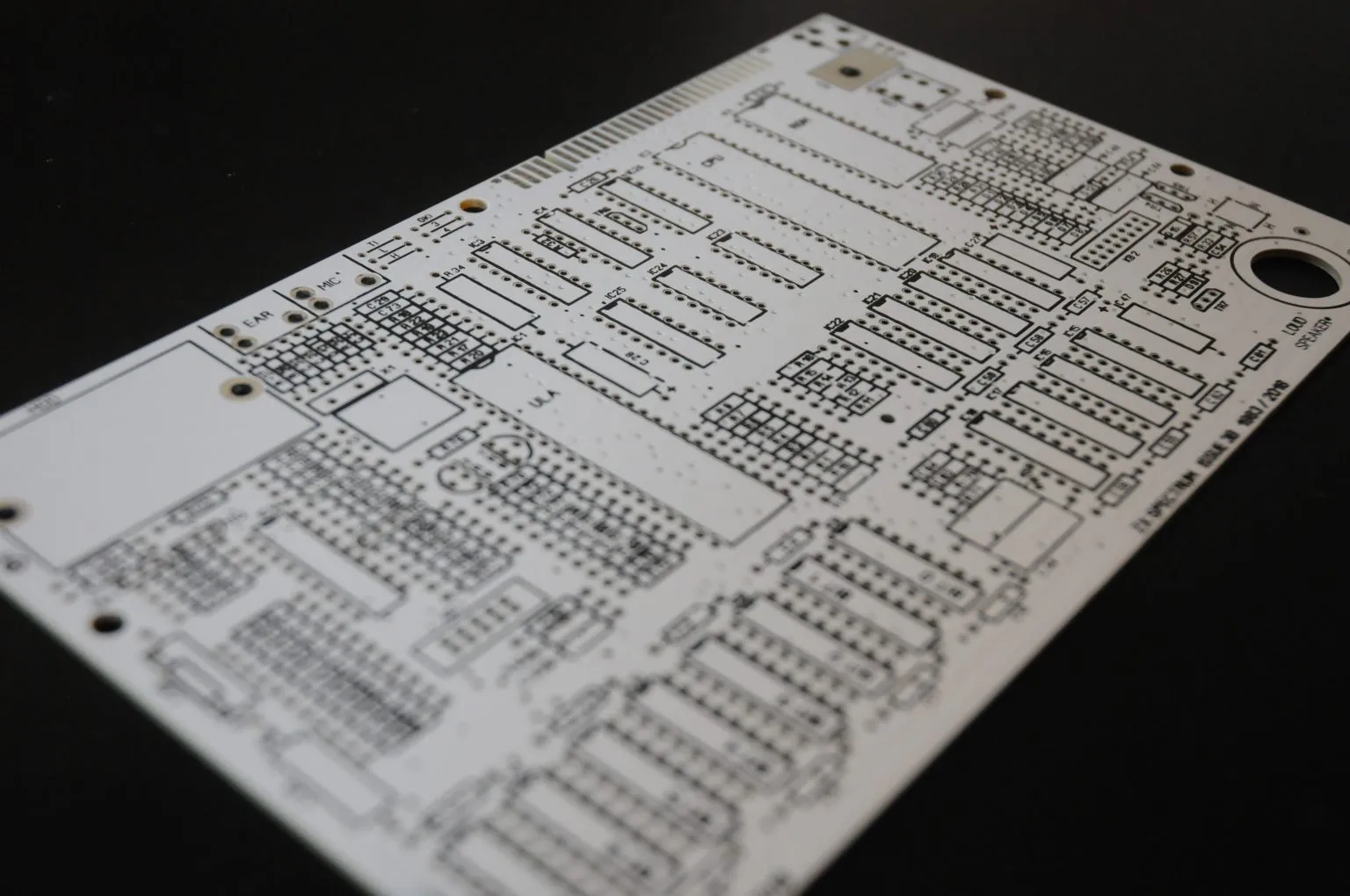
The Spectrum has an extremely active community, helped by the machine’s longevity in Eastern Europe, where games and demos are still being written for it today. I went into the project assuming I’d have to learn Eagle to lay out the PCB, but somebody had already done it and put the Gerbers up for download (thank you, Pabb). More research surfaced huge discussions about alternative chips on spectrumcomputing.co.uk and a handful of Facebook groups.
I started a Google Sheet listing the original BOM, then in the next column either a modern equivalent chip or a modern recreation. To my surprise, all the resistors, diodes and capacitors are still manufactured (some in slightly different footprints, but that doesn’t matter). The Z80 still shows its resilience — it’s still in production long after debuting in 1976, which makes it as old as me.
The upper and lower RAM aren’t made any more, but modern recreations are available using LPSRAM in place of the notoriously flaky 4116s. All the 74xxx logic chips up the top of the board have direct modern equivalents. The ROM lives on a programmable EEPROM, and Amstrad — current owners of the Sinclair copyright — have, in a happy turn, allowed free use of the ROM image for years now.
Which leaves the LM1889N video modulator, the only chip I haven’t yet found a modern equivalent or recreation for. It sits in my board (and on my conscience) as the only New Old Stock part on the entire build. I’ve noticed the latest revision of the vULA has video output of its own — there’s a chance that closes the loop. A new delivery from New Zealand is in the post; fingers crossed.
Putting it together
Assembly was an enjoyable process of straightforward soldering, with a slowly-growing compulsion about aligning the resistor stripes neatly with their neighbours. Building a complete computer from components you can order from any electronics supplier — ULA aside — was strange and satisfying. Powering it up for the first time and seeing ”© 1982 Sinclair Research Limited” on the TV was invigorating. Loading Manic Miner (the greatest game ever to exist, but that’s another article) was the proverbial cherry.
Recreating the rest of 1983
I wanted to take the project further and recreate the whole 1983 experience: the box, the manuals, and most importantly the Horizons tape. For a lot of us, Horizons was our first journey into computing — turning the TV into a portal to another universe, whether that was the joy of Thro’ The Wall or learning about population control via the foxes and rabbits of Evolution. The seemingly primitive BASIC programs of the time inspired a generation of careers. I doubt the PS5 and Series X will ever have the same effect on their users. I feel extremely lucky to have been there for it.
Remarkably, I found a tape recorder with a record function in Argos. That let me convert a .tap image of Horizons into a .wav file and play those familiar screeches from the PC into the recorder. After a few attempts to get the audio levels right, I had a tape that loaded Horizons cleanly.
For the tape cover I tracked down a source, scanned it, identified the fonts, redrew the logos, and photographed my Issue 1 Spectrum to compose the best-quality cover I could, then sent it off to a professional printer.
The manuals were essential. The internal pages were already scanned at high resolution and easy to obtain; the cover required recreation. The original artwork — “Floating City” by John Harris — had been beautifully redrawn by Gary Arnott on Twitter some time ago. I tracked down a high-resolution version, did a fair amount of colour and level correction in Photoshop, and got it as close to my reference manual as I could. InDesign for layout, then off to a print and binding house.
Finally, the box. There’s someone online selling reproduction covers and poly inserts, so I started there. Their version is good but not perfect, so I’ve been recreating the artwork to better match the original and to print on a paper stock closer to the real thing. I’ll put the files up for anyone to use once they’re done.
The reboxing
I never actually got to unbox a new Spectrum while they were still in production. I was bought one for my seventh birthday, and my parents — in a rare fit of technical ability — set it up in the living room with “Happy Birthday, Charles” on the screen. To this day I have no idea how they managed it; my mother once phoned me at work to ask how to “go to a new line” on her PC, having seemingly never used the return key.
So forty years later, after what someone in the comments called a “reboxing”, I finally got the experience of opening a fully boxed 48k Spectrum with all the trimmings. I couldn’t be happier.
One bad comment, a thousand good ones
Going back to that one negative YouTube comment — it was striking that every other message was lovely. People sharing memories of their Spectrum and other 8-bit machines. People inspired to dig theirs out of the loft, or to build their own. It reminded me of the early days of the internet, when we used to chat in comp.sys.sinclair and IRC, where the worst bullying you got was light jibes for admitting you also liked the C64 (for the removal of doubt — I do).
For that reason alone, this feels like a job well done. Right — onto the next one. Look out, Commodore. Updates and the full build log live at lostretrotapes.com.